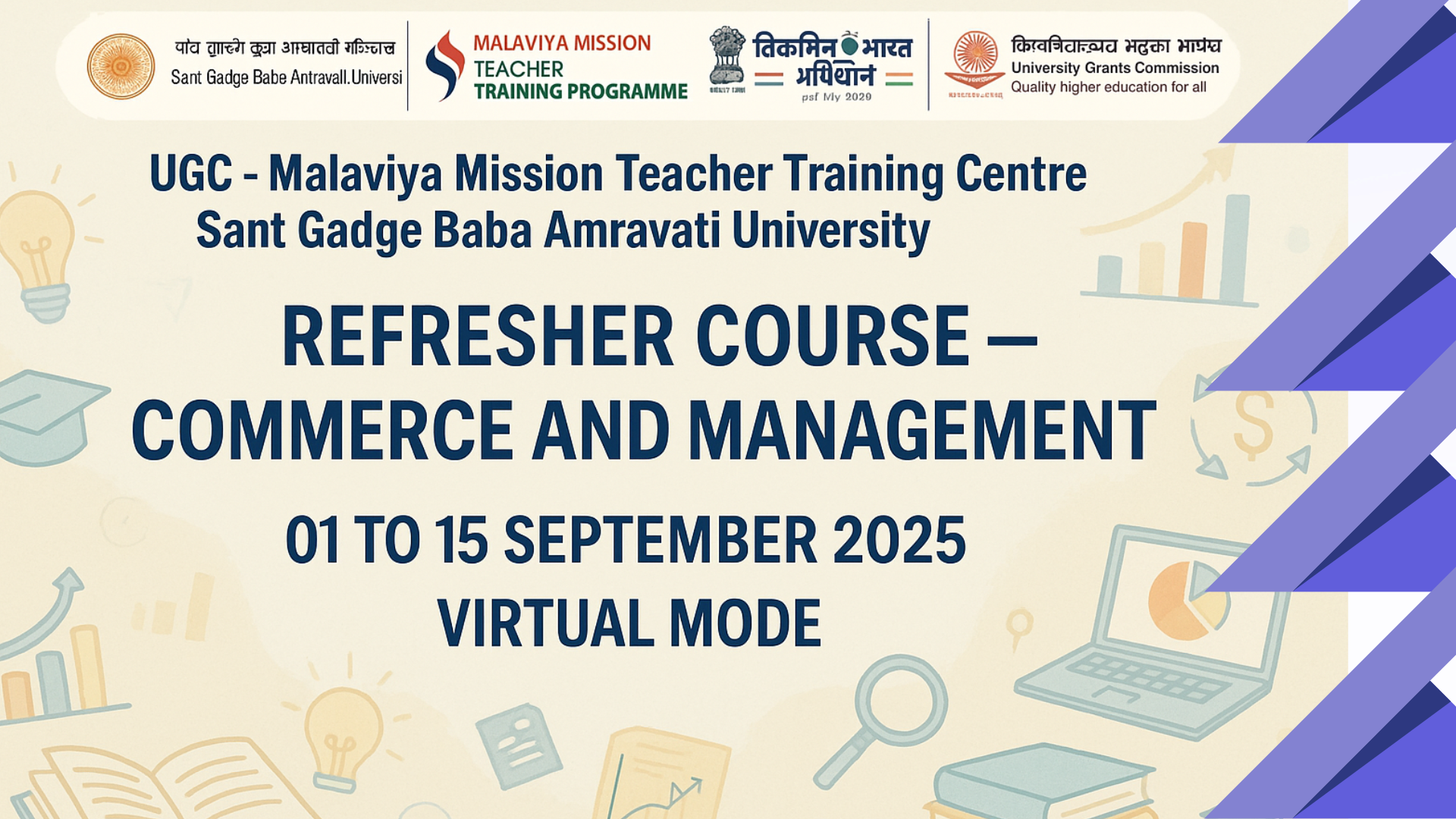
Prologue
The landscape of higher education in commerce and management is undergoing a paradigm shift under the transformative vision of the National Education Policy (NEP) 2020. The growing demand for innovation-driven business education, integration of multidisciplinary approaches, digital transformation, and outcome-based learning calls for a renewed perspective among faculty members. This refresher course is designed to empower educators with contemporary pedagogical practices, technology-enabled teaching, and research-driven insights, fostering a culture of academic excellence and entrepreneurship. The programme is a vital step towards aligning teaching-learning and assessment in commerce and management with NEP-2020’s guiding principles, ensuring that faculty members are well-equipped to prepare students for the challenges of a globalized economy.
Commerce and
Management disciplines are undergoing rapid transformation with significant
implications from tax reforms (GST, Direct & Indirect tax changes), tariff
wars, global trade disruptions, digital innovations, and ESG-driven business
practices.
This FDP aims to provide participants with cutting-edge insights into global
business outlook, commerce trends, tax reforms, tariff challenges, and
resilience strategies, equipping educators with modern pedagogical tools and
research approaches.
Objectives
- To explore recent developments in tax reforms, GST, and their impact on business ecosystems.
- To understand the implications of tariff wars and global trade policies on commerce and management.
- To examine emerging commerce trends such as digital commerce, fintech, and ESG reporting.
- To analyze the global outlook in business and economics, linking theory with real-world policy changes.
- To equip faculty with research tools, ICT skills, and pedagogical approaches aligned with NEP 2020.
- To prepare educators for transforming business education toward a resilient future.
Learning Outcomes
By the end of the course, participating faculty members will be able to:
- Interpret and teach the impact of GST, tax reforms, and tariff wars in a global context.
- Integrate business management strategies (leadership, HR analytics, sustainability) into teaching and research.
- Apply econometric and policy analysis tools for economic and business decision-making.
- Use ICT tools, data analysis software (Excel, SPSS, R), and AI applications in academic research.
- Develop multidisciplinary and skill-based curriculum models for Commerce and Management education.
- Course Coordinator: Dipak Chacharkar
- Course Coordinator: Ankita Ojha