Prologue
In the contemporary knowledge economy, creativity and innovation have emerged as essential drivers of sustainable development, entrepreneurship, and institutional transformation. Higher education institutions are increasingly expected to foster an ecosystem where ideas are nurtured, transformed into solutions, and translated into socially relevant innovations. In this context, the integration of creative thinking, design methodologies, technological awareness, and entrepreneurial orientation has become indispensable for faculty members, researchers, and students.
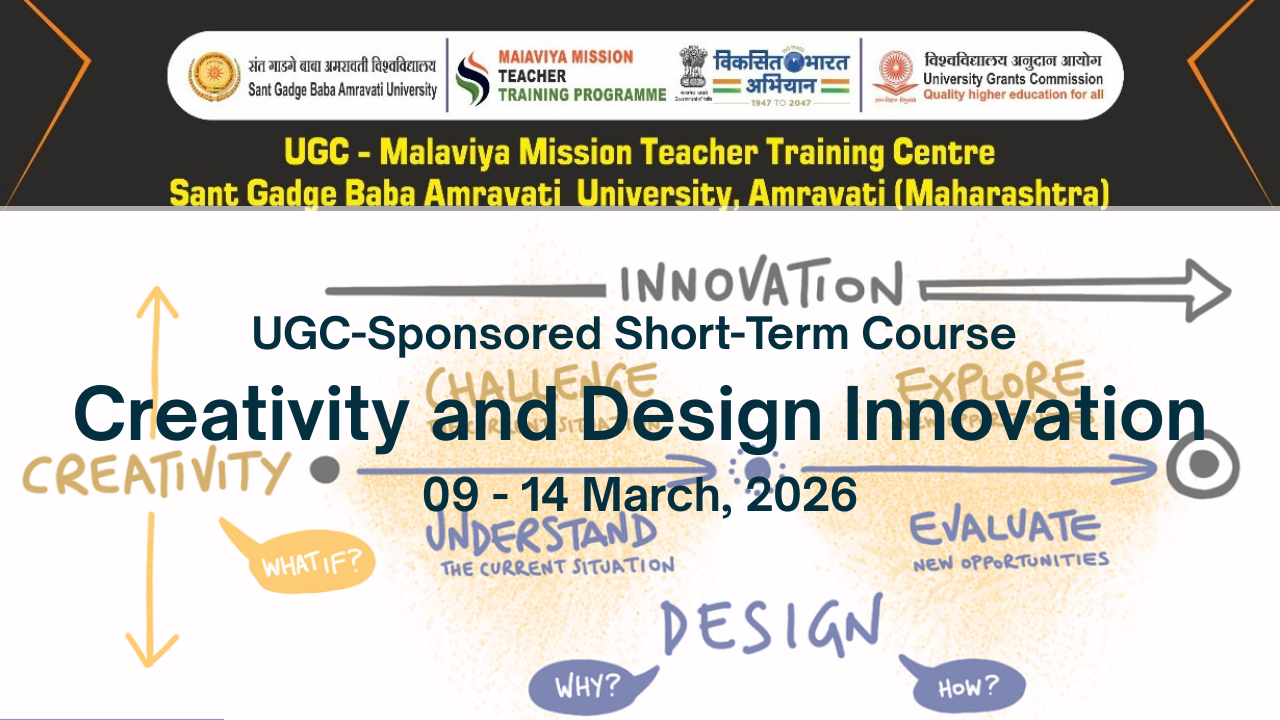
The Short-Term Course on “Creativity and Design Innovation” aims to introduce participants to the principles of creative problem-solving and design thinking while connecting these concepts with entrepreneurship, market understanding, and innovation ecosystems. The programme emphasizes the process of transforming ideas into viable products, services, or enterprises through systematic approaches such as problem identification, design thinking, product-market alignment, intellectual property protection, and incubation support.
The course will also explore the role of academic incubation centres, emerging technologies, and intellectual property rights (IPR) in nurturing innovation within universities and research institutions. Through interactive sessions, case studies, and practical frameworks, participants will gain insights into how creativity can be structured, nurtured, and implemented within teaching, research, and institutional innovation initiatives.
Aligned with the spirit of NEP-2020, the programme seeks to promote multidisciplinary thinking, experiential learning, and innovation-driven pedagogy. By engaging with contemporary innovation practices and entrepreneurial models, the course will empower participants to cultivate a culture of creativity and problem-solving within their academic and professional environments.
Objectives
The Short-Term Course is designed with the following objectives:
- To introduce the conceptual foundations of creativity, innovation, and design thinking in the context of higher education and entrepreneurship.
- To develop the ability to identify real-world problems and convert them into innovative opportunities through structured creative processes.
- To familiarize participants with the stages of innovation development, from ideation to product design, market validation, and venture creation.
- To provide product insights—market fit and market analysis, enabling participants to understand the commercial viability of innovative ideas.
- To explore the role of incubation centres and innovation ecosystems in academic institutions for supporting startups and entrepreneurial initiatives.
- To enhance awareness about Intellectual Property Rights (IPR) and their importance in protecting and commercializing innovations.
- To examine the role of emerging technologies in enabling innovation and new entrepreneurial opportunities.
- To encourage participants to integrate creative and design-based approaches into teaching, research, and institutional innovation activities.
Learning Outcomes
Upon successful completion of the course, participants will be able to:
- Understand and apply the principles of creativity and design thinking in problem-solving and innovation processes.
- Identify societal, technological, or institutional challenges and convert them into opportunities for innovative solutions.
- Analyze market needs and assess product–market fit for potential innovations or entrepreneurial ventures.
- Develop conceptual frameworks for transforming ideas into viable products, services, or startups.
- Explain the significance of academic incubation centres and innovation ecosystems in fostering entrepreneurship within higher education institutions.
- Demonstrate awareness of Intellectual Property Rights (IPR) mechanisms and their role in safeguarding innovations.
- Recognize the potential of emerging technologies in creating new entrepreneurial opportunities and innovative solutions.
- Integrate creativity-driven and innovation-oriented approaches into teaching, research, and institutional development initiatives.
- Course Coordinator: Swati Sherekar