Prologue: -
The rapid transformation of higher education in the twenty-first century, driven by digital technologies, artificial intelligence, open educational resources, and innovative pedagogical frameworks, necessitates the continuous professional development of educators. The NEP-2020 envisions a learner-centric, multidisciplinary, technology-enabled, inclusive, and globally competitive education ecosystem that equips learners with the competencies required for a knowledge-driven society.
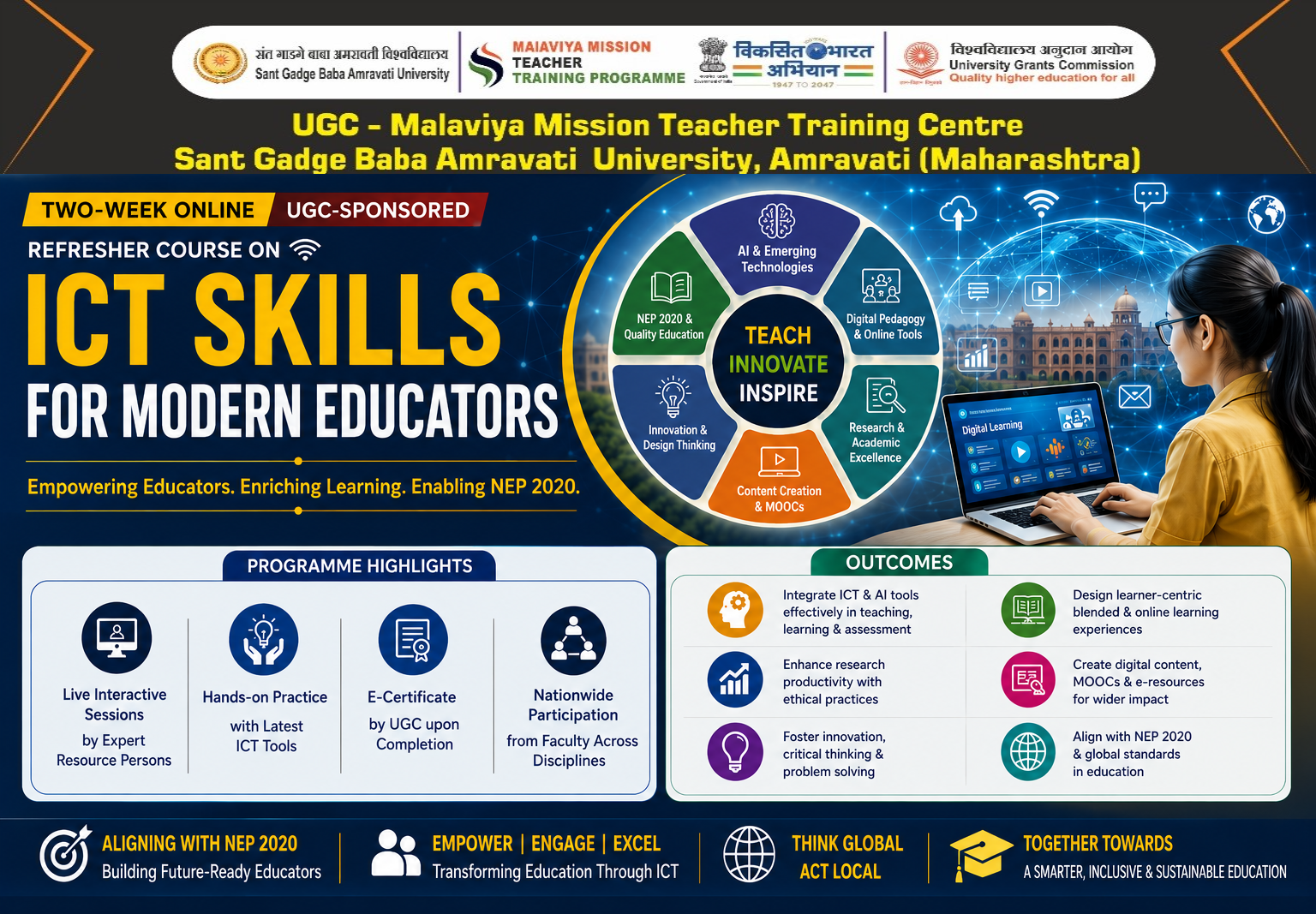
In this context, the Malaviya Mission Teacher Training Centre (MMTTC), Sant Gadge Baba Amravati University, Amravati, is organizing a Two-Week Online UGC-Sponsored Refresher Course on “ICT Skills for Modern Educators.” The programme is designed to empower faculty members with advanced digital competencies, emerging educational technologies, AI-enabled teaching-learning practices, innovative assessment methodologies, digital content development skills, research capabilities, and ethical academic practices.
The course integrates contemporary themes such as Learning Management Systems, Generative Artificial Intelligence, Prompt Engineering, MOOCs and e-Content Design, Digital Research Tools, IoT Applications, Research and Publication Ethics, Open Access Resources, and Technology-Enabled Pedagogy. Aligned with the vision of NEP 2020, Sustainable Development Goal 4 (Quality Education), and global best practices in higher education, the programme seeks to develop future-ready educators capable of fostering innovation, excellence, inclusivity, and lifelong learning in an increasingly digital academic environment.
Objectives: -
- To enhance digital and technological competencies among higher education faculty members by providing hands-on exposure to contemporary ICT tools, learning management systems, digital assessment platforms, AI applications, and emerging educational technologies.
- To promote innovative, learner-centric, and outcome-based pedagogical practices aligned with NEP 2020 through the integration of digital tools, blended learning, online teaching methodologies, and interactive learning environments.
- To strengthen the research and scholarly capabilities of educators through training in scientific literature review, research proposal development, research ethics, publication standards, open-access resources, and digital research tools.
- To develop competencies in digital content creation and dissemination, including e-content development, MOOCs design, e-book creation, multimedia learning resources, and technology-enabled knowledge sharing.
- To foster a culture of innovation, critical thinking, and global academic engagement by introducing faculty members to Artificial Intelligence, Prompt Engineering, Design Thinking, IoT applications, and emerging trends shaping the future of education.
Expected Outcomes: -
- Faculty members will acquire advanced ICT skills enabling effective integration of digital technologies, AI tools, and online learning platforms into teaching, assessment, and academic administration.
- Participants will be able to design and implement learner-centric educational experiences through blended learning, MOOCs, e-content development, digital assessments, and outcome-based instructional strategies.
- Educators will demonstrate enhanced research productivity and quality through improved competencies in literature review, proposal writing, ethical publishing, academic communication, and utilization of digital scholarly resources.
- Participants will create technology-enabled educational resources, including interactive presentations, e-books, MOOCs, digital learning materials, and AI-assisted instructional content aligned with national and international quality standards.
- Faculty members will emerge as digitally empowered academic leaders and change agents capable of advancing the goals of NEP-2020, promoting innovation-driven education, supporting lifelong learning, and contributing to globally competitive higher education institutions.
- Course Coordinator: Dr. Avinash Manwar