1. Introduction
Biological Sciences is a rapidly advancing and interdisciplinary field concerned with the study of life, living organisms, their functions, evolution, and interactions with the environment. It encompasses diverse disciplines, including Biotechnology, Genetics, Microbiology, Molecular Biology, Biochemistry, Botany, Zoology, Ecology, Environmental Sciences and allied domains.
Recent advancements in biotechnology, genomics, bioinformatics, artificial intelligence, and emerging research technologies have significantly transformed biological education and research. These developments offer new opportunities to address challenges in healthcare, agriculture, biodiversity, and environmental sustainability.
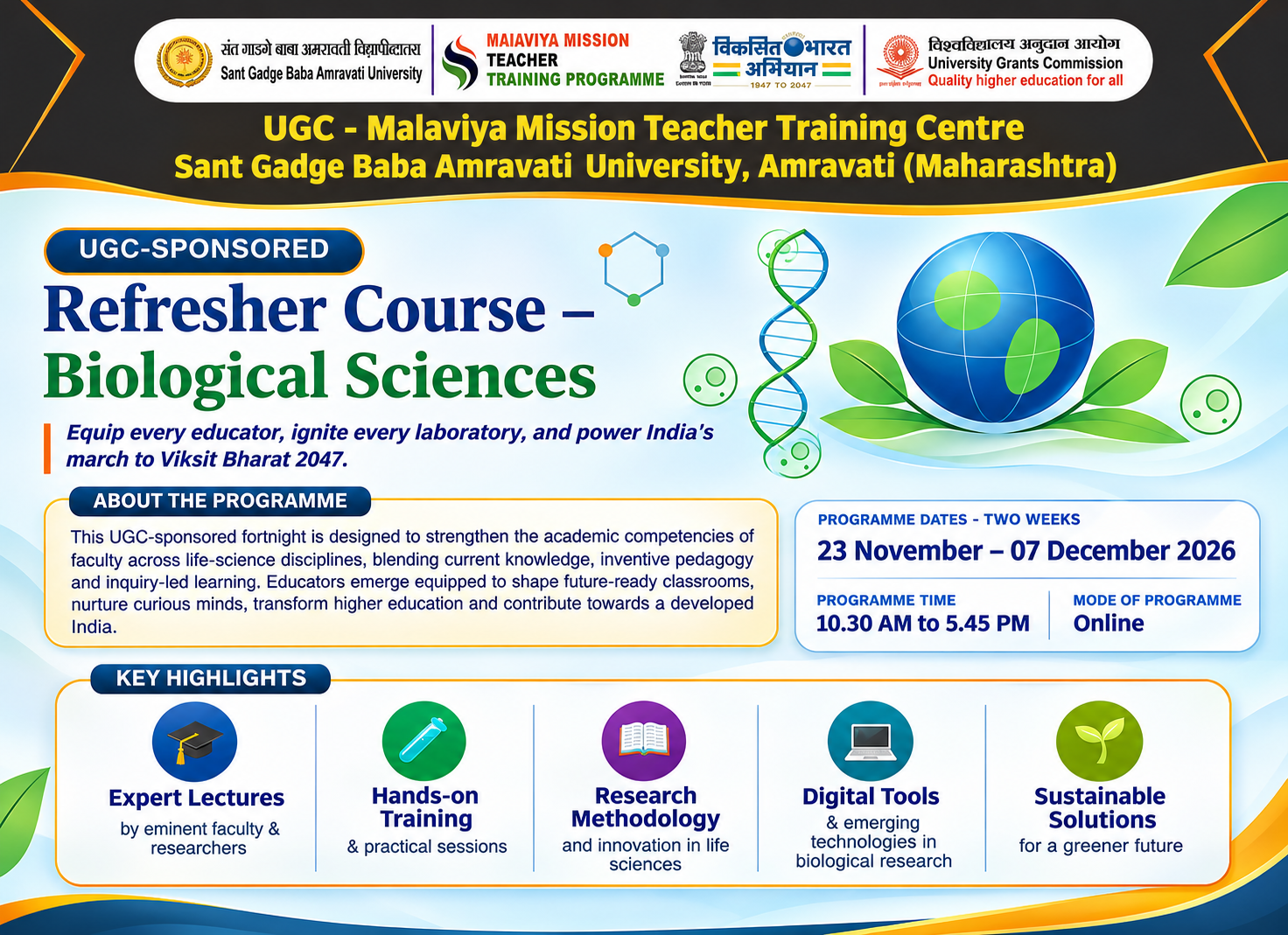
The UGC-Sponsored Refresher Course-Biological Sciences aims to update faculty members with contemporary scientific knowledge, innovative pedagogical practices, emerging technologies, and modern research methodologies. The programme seeks to strengthen teaching and research competencies, promote interdisciplinary collaboration, and encourage scientific innovation in alignment with NEP-2020 and Viksit Bharat 2047.
2. Objectives
-
To update participants' knowledge of recent advancements and emerging trends in Biological Sciences.
-
To strengthen research competencies through contemporary methodologies, analytical techniques, and interdisciplinary approaches.
-
To promote innovative teaching-learning practices and the integration of digital technologies and artificial intelligence.
-
To encourage research collaboration, scientific inquiry, and innovation across biological disciplines.
-
To enhance awareness of the applications of Biological Sciences in healthcare, agriculture, biodiversity, and sustainable development.
3. Expected Learning Outcomes
Upon successful completion of the course, participants will be able to:
-
Explain emerging concepts, scientific developments, and contemporary applications in Biological Sciences.
-
Apply modern research methodologies, analytical techniques, and interdisciplinary approaches in teaching and research.
-
Integrate innovative pedagogical practices, digital tools, and artificial intelligence into academic activities.
-
Develop research ideas and collaborative approaches to address contemporary scientific challenges.
-
Evaluate the role of Biological Sciences in promoting scientific innovation, environmental sustainability, and societal development.
- Teacher: Dr. Varsha S. Kumar