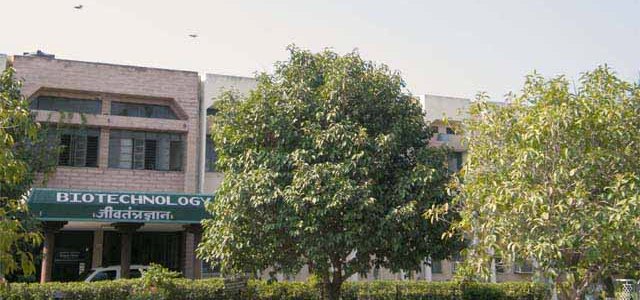
This is a course created for conducting Online Biotechnology Test for the year 2024.
- Teacher: UGC MMTTC
Category: Department of Biotechnology - SGBAU
This is a course created for conducting Online Biotechnology Test for the year 2024.
Admission to M.Sc. Biotechnology - Sant Gadge Baba Amravati University, Amravati 444602 Maharashtra
There shall be an Entrance Examination for M.Sc. Biotechnology (Two Year degree Course – Semester Pattern). The question paper for the entrance examination will be of two hours duration and divided into two parts:
Part A will have multiple choice questions at the level of 10 + 2. The questions will be asked from Physics, Chemistry, Mathematics and Biology. There will be 30 questions. Each question will carry one mark (Total Marks for Part A – 30).
Part B will also have multiple choice questions at the level of Bachelor Degree. There will be 10 questions from Chemistry and 60 questions from Biology (Botany, Zoology, Biochemistry, Microbiology, Genetics, Biotechnology). Each question will carry one mark. (Total Marks for Part B– 70).
Sample questions
In order to give an idea about the standard of questions expected to be answered by the candidates, a set of sample questions is given below. However, it may be noted that the pattern of question may change from year to year.
Part A
Cryogenics deals with the study of matter
a) Near absolute zero b) At low temperature
c) At high temperature d) Near zero degree Celsius
When on heating, a solid becomes vapour without forming any liquid, it is said to have sublimed. Which of the following sublimes on heating?
a) Salt b) Iodine
c) Iron d) Calcium
Which non-toxic,fast growing cyanobacterium is cultivated in tanks as a protein – rich animal feed?
a) Stigonema b) Spirulina
c) Nostoc d) Oscillatoria
Beena used a calculator to find the product 0.075 x 2.56. She forgot to enter the decimal points. The calculator showed 19200. If Beena had entered the decimal points correctly, the answer would have been -
a) 0.0192 b) 0.192
c) 1.92 d) 19.2
Part B
Emasculation of the flower means
a)Removal of flower b) Removal of petals
c) Removal of anthers d) Removal of stigma
The somatic characters which are located on sex chromosome are called –
a) Sex determination b) Sex linked characters
c) Complete linkage d) Incomplete linkage
In which of the following cellular respiration occurs
a)Ribosome b) Nucleus
c) Mitochondria d) Golgi bodies
Protein part of the enzyme is called
a)Prosthetic group b) Apoenzyme
c) Holoenzyme d) All of these
In Gram positive bacteria, the cell membrane becomes invaginated and folded to form structures called -
a) Flagella b) Plasmid
c) Mesosomes d) Peroxisomes
If the plant cell or the tissue is placed in hypertonic solution the water comes out of the cell sap into the outer solution and the cell becomes flaccid. This process is known as –
a) Turgor pressure b) Wall pressure
c) Exosmosis d) Endosmosis
The scientist who shared Nobel prize with James D Watson and F. Crick for the structure of DNA
a)Har Govind Khurana b) Nirenberg
c) Maurice Wilkins d) Swaminathan
The technique to determine the protein binding sites on DNA is called as –
a) DNA fingerprinting b) DNA foot printing
c) RFLP d) AFLP
Introduction:
As everyone knows, the COVID-19 Pandemic has dramatically changed education with tremendous change in the entire Higher Education System. It has created a distinctive need of E-learning & teaching in all areas including remote areas. Even before this pandemic, Information Communication Technology was emerged at high speed, but this pandemic made all of us technical experts to sustain in the virtual world. In the system of Higher Education & even in society, teachers are pivots of the education system and play a very important role hence, they need to evolve more than ever, an innovative approach to equip themselves with the skills necessary to create a holistic and stress-free learning environment for teaching and learning.
Education is the single most important instrument for social & economic transformation. Various government initiatives are being adopted to boost the growth of the education system, besides focusing on new education techniques, such as E-learning and M-learning. In contemporary times our Universities cannot promote an academic life in isolation but are required to champion reason and imagination in engagement with the wider society and its concerns.
While it is universally accepted that the teacher is the pivot of the educational system, our system does not provide adequate opportunities for their professional development. Being a teacher sharpens the intellects of students, is considered an important source of this drastic transformation of students.
Realizing that teachers have to be in the centre stage of these developments, provisions for their motivational training and consistent exposure to innovative trends and advanced knowledge in various disciplines and across disciplines, need to be revisited and re-engineered in consonance with the contemporary scenario of the country. Not only the faculty but new strategies for the governance of educational institutions are also needed to promote innovative, broad and dynamic collaborative models. Under the given scenario it is expected that teachers will assure the role of a leader & facilitator.
Kothari Commission (1964) remarks, it is education that determines the level of prosperity, welfare & security of the people. It is still relevant in the context of teacher education.
Teacher Education in India, over the years, has been striving to make the teachers internalize this mission & steer them towards achieving it. But unlike the teachers in school education, a faculty in higher education joins the teaching profession without any formal training in teaching, learning & assessment. Understanding the capabilities in these areas along with the awareness of policies, governance & administrative structures can help new teachers entering higher education to improve teaching and management skills, adjust to the culture of higher education institutions and better understand their professional responsibilities. The teacher are also expected to have a clear understanding of planning curriculum & pedagogical strategies, generating new knowledge for an equitable society, maintenance of academic integrity and integrating sustainability in teaching and personal life. Quality of education is determined as well as dependent on the quality of teachers.
Faculty Induction through the Malaviya Teacher Training Centre constitutes an important strategy for achieving faculty excellence along with all the above goals.
The present higher education system focuses only on the subject knowledge of the faculty. It does not focus on the teaching-learning process, pedagogical content and various tools which are very vital to increase the quality of learning experience in different educational programmes.
Hence, it will be mandatory for newly appointed faculty to undergo Faculty Induction Programme after their appointment in Higher Education institutions.
This Induction Programme will include teaching and research methodologies (Flip classrooms, collaborative learning, case approach) Use of ICT, curriculum structure and design, sensitization to gender and social diversity, professional ethics, sharing of best practices and updating development in the field of study etc.
The Faculty Induction Programme has a critical role to play in promoting academic excellence and innovation. This is one of the priority actions aimed at improving the professional capability and performance of teachers to deliver effective and quality learning.
Hence, the Faculty Induction Programme will include four possible types of development:
UGC-Malviya Mission Teacher Training Centre of Sant Gadge Baba Amravati University, Amravati has conducted the Faculty Induction Programme by keeping all above in mind. The Faculty Induction Programme is of one-month duration consisting of 24 working days. (24x04=96) for each day 06 contact hours each of 90 minutes duration. Along with these live sessions, various assignments/ Project Proposal writing/ MCQ tests / Microteaching technique assignments will be given to teacher participants to complete contact hours.
Evaluation & Grading will be carried out strictly by considering Gurudakshata and UGC MMTTC guidelines. There will be live interaction among participants and Resource Persons for almost all sessions. Group Discussion was also carried out for a few sessions as per the needs of topics.
The entire programme was based on Gurudakshata & Resource Persons were invited strictly on the basis of modules given in Gurudakshata. Almost all modules in the range of 70 to 90% were completed by eminent experts across India.
Objectives:
The Faculty Induction Programme of our Malviya mission teacher training Centre is planned & designed on the basis of Gurudakshata modules to fulfil all specific objectives listed below. Those objectives can orient teacher participants on various generic aspects of Teaching and Learning, Instructional Methodologies, Assessment & Evaluation Techniques. ICT enabled teaching & learning etc. and equip them with knowledge of University rules & regulations, basics of governance & administrations.
1. To understand the roles and responsibilities of assistant professors - in
the institution, society etc.
2. To make them understand various pedagogical processes with
reference to :
a. Use of Resource & Assessment
b. Management of Classroom & Transaction
c. Aims of Higher Education
d. Institutional Planning
3. To develop Various skills among participants
4. To make them familiarize with structure functioning, governance, rules, regulations, professional expectations in educational institution.
5. To train them for various ICT based methods and techniques of evaluation, teaching, learning, E-content development etc.
6. To make them aware about administrative set-up.
7. To sensitize them about classroom realities.
8. To understand the bond between different stakeholders for realizing
the professional aspirations.
9. To develop them as agents of socio economic change for national development.
10. To create awareness of about environment and sustainable development.
11. To make them understand role of facilitators.
12. To adopt transformative and innovative approaches in higher education.
13. To understand significance of higher education.
14. To acquire and improve basic skills of teaching at the college and university level.
15. To understand the organization and management of a college/University.
16. To create and utilize opportunities of personality initiative and creativity.
17. To provide a comprehensive and structured look at the challenges and
opportunities brought by the use of ICT & Open content (OER &
MOOCs) in higher education.
18. To sensitize and motivate the faculty to adopt learner centered approaches.
19. To promote academic excellence, teaching innovation research capabilities & leadership skills.
20. To improve professional capabilities and teacher performance of
teachers to deliver effective and quality learning.
Learning Outcomes
By the end of the Faculty Induction Programme (Guru Dakshta), participants will be able to:
Introduction:
As everyone knows, the COVID-19 pandemic has dramatically changed education with tremendous change in the entire higher education system. It has created a distinctive need for e-learning & teaching in all areas, including remote areas. Even before this pandemic, information communication technology emerged at high speed, but this pandemic made all of us technical experts sustain in the virtual world. In the system of higher education & even in society, teachers are pivots of the education system and play a very important role; hence, they need to evolve more than ever, an innovative approach to equip themselves with the skills necessary to create a holistic and stress-free learning environment for teaching and learning.
Education is the single most important instrument for social & economic transformation. Various government initiatives are being adopted to boost the growth of the education system, besides focusing on new education techniques, such as e-learning and m-learning. In contemporary times our universities cannot promote an academic life in isolation but are required to champion reason and imagination in engagement with the wider society and its concerns.
While it is universally accepted that the teacher is the pivot of the educational system, our system does not provide adequate opportunities for their professional development. Being a teacher sharpens the intellects of students and is considered an important source of this drastic transformation of students.
Realizing that teachers have to be in the centre stage of these developments, provisions for their motivational training and consistent exposure to innovative trends and advanced knowledge in various disciplines and across disciplines need to be revisited and re-engineered in consonance with the contemporary scenario of the country. Not only the faculty but also new strategies for the governance of educational institutions are also needed to promote innovative, broad, and dynamic collaborative models. Under the given scenario it is expected that teachers will assume the role of a leader & facilitator.
Kothari Commission (1964) remarks that it is education that determines the level of prosperity, welfare, & security of the people. It is still relevant in the context of teacher education.
Teacher education in India, over the years, has been striving to make the teachers internalize this mission & steer them towards achieving it. But unlike the teachers in school education, a faculty in higher education joins the teaching profession without any formal training in teaching, learning, & assessment. Understanding the capabilities in these areas, along with the awareness of policies, governance, & administrative structures, can help new teachers entering higher education to improve their teaching and management skills, adjust to the culture of higher education institutions, and better understand their professional responsibilities. The teachers are also expected to have a clear understanding of planning curriculum & pedagogical strategies, generating new knowledge for an equitable society, maintenance of academic integrity,, and integrating sustainability in teaching and personal life. Quality of education is determined as well as dependent on the quality of teachers.
Faculty induction through the Malaviya Teacher Training Centre constitutes an important strategy for achieving faculty excellence along with all the above goals.
The present higher education system focuses only on the subject knowledge of the faculty. It does not focus on the teaching-learning process, pedagogical content, and various tools, which are very vital to increasing the quality of the learning experience in different educational programs.
Hence, it will be mandatory for newly appointed faculty to undergo the Faculty Induction Programme after their appointment in higher education institutions.
This Induction Programme will include teaching and research methodologies (Flip classrooms, collaborative learning, case approach), Use of ICT, curriculum structure and design, sensitization to gender and social diversity, professional ethics, sharing of best practices and updating development in the field of study, etc.
The Faculty Induction Programme has a critical role to play in promoting academic excellence and innovation. This is one of the priority actions aimed at improving the professional capability and performance of teachers to deliver effective and quality learning.
Hence, the Faculty Induction Programme will include four possible types of development:
UGC-Malviya Mission Teacher Training Centre of Sant Gadge Baba Amravati University, Amravati, has conducted the Faculty Induction Programme by keeping all the above in mind. The Faculty Induction Programme is of one-month duration, consisting of 24 working days. (24x04=96) for each day, 06 contact hours each of 90 minutes duration. Along with these live sessions, various assignments, project proposal writing, MCQ tests, and microteaching technique assignments will be given to teacher participants to complete contact hours.
Evaluation & Grading will be carried out strictly by considering Gurudakshata and UGC MMTTC guidelines. There will be live interaction among participants and resource persons for almost all sessions. Group discussion was also carried out for a few sessions as per the needs of topics. The entire programme was based on Gurudakshata, & resource persons were invited strictly on the basis of modules given in Gurudakshata. Almost all modules in the range of 70 to 90% were completed by eminent experts across India.
Objectives:
The Faculty Induction Programme of our Malaviya Mission Teacher Training Centre is planned & designed based on Gurudakshata modules to fulfil all specific objectives listed below. Those objectives can orient teacher participants on various generic aspects of teaching and learning, instructional methodologies, and assessment & evaluation techniques. ICT-enabled teaching & learning, etc., and equip them with knowledge of university rules & regulations, basics of governance & administration.
Learning Outcomes
By the end of the Faculty Induction Programme (Guru Dakshta), participants will be able to:
Introduction: -
The environment includes all living organisms and all natural resources on planet Earth. These biotic and abiotic factors influence each other. Microorganisms, plants, animals, and human beings are examples of biotic factors, while abiotic factors include air, water, soil, land, sunlight, etc. There is an interlinking and interdependence among these biotic and abiotic factors. Environmental science includes systematic and scientific study of all these factors.
Environmental resources are very important for all living organisms. Resources are both renewable and non-renewable. Renewable resources are those that can be used without the possibility of the resource becoming depleted or exhausted. That is, a continuous supply of the resource remains available. Examples of renewable resources are the trees in the forests and the fish in the ocean; on the other hand, non-renewable resources are those that get exhausted with extraction and use, for example, fossil fuel. The environment also assimilates waste generated by all living organisms. It sustains life by providing genetics and biodiversity and it also provides aesthetic services like scenery, etc.
The increase in population, unlimited use of natural resources, accumulation of solid waste, including hazardous waste, and pollution of all kinds of environments to a large extent have deteriorated the environment at the global level. Today the world is facing its consequences. We all have to take steps for the conservation of the environment at local, national, and global levels. Sustainable development is a development that meets the needs of the present without compromising the ability of future generations to meet their own needs. The concept of sustainable development can be interpreted in many different ways, but at its core is an approach to development that looks to balance different, and often competing, needs against an awareness of the environmental, social, and economic limitations we face as a society.
Objectives: -
Outcomes: -
The Refresher Course in Information and Communication Technology (ICT) is designed to meet the demands of contemporary education systems and contribute to the vision of NEP-2020. This course empowers faculty with advanced ICT skills and pedagogical techniques. With the transformative focus of NEP-2020 on digital integration and holistic education, this course aims to prepare educators for the challenges and opportunities of a rapidly evolving digital learning ecosystem. Participants will gain insights into the latest ICT tools, innovative teaching methodologies, and effective use of technology in enhancing learning outcomes.
Objectives:
Learning Outcomes:
Upon successful completion of the course, participants will be able to:
This refresher course is designed to equip higher education faculty with the necessary skills and knowledge to effectively utilize MOOCs (Massive Open Online Courses), develop e-content, and leverage Open Educational Resources (OERs) in their teaching practices. The course combines live sessions, tutorials, assignments, case studies, and proctored assessments to provide a comprehensive learning experience.
Objectives:
By the end of the course, participants will have gained valuable insights and practical skills to leverage digital technologies and resources effectively in their teaching endeavors, thus enhancing the quality and accessibility of higher education.
Introduction
Health is wealth and everyone must give prime importance to health. As per the definition of health given by WHO, health does not mean merely the absence of physical disease it also includes social and mental wellbeing. To be healthy as per WHO we need to take care of our physical, mental and social health. Health mainly depends on lifestyle. Lifestyle means a typical way of life of an individual, group or culture. If you adopt a healthy lifestyle then you can improve your health status also. The second aspect is taking care of health, especially under particular health conditions for example high blood pressure, cardiovascular disease, diabetes or thyroid disorder etc. One can prevent further complications of all these disorders by taking care of his or her health. This healthcare management needs to adopt a typical lifestyle along with medication or proper treatment. A very important aspect is of mental health. Nowadays our lifestyle has become very hectic and stressful. Work-life balance, competition, time pressure, financial management, Environmental pollution, nuclear families, and the use of technology and social media all these factors are contributing to the deterioration of our mental health. We are not giving enough time to our health. By considering all this the Malaviya Mission Teacher Training Centre, Sant Gadge Baba Amravati University, Amravati, Maharashtra has organised a short-term course on this theme of Lifestyle and Health Care Management for the first time by keeping the following Objectives:
Programme Outcomes
At the end of the programme participants will be able to: -
Learning Outcomes:
Develop learning outcomes for a 4-credit course and individual modules.
Critically compare the Flipped Learning model with traditional classroom methods, highlighting the transformed role of the teacher.
Select and employ appropriate ICT tools for developing in-class and Out-of-Class learning activities.
Design structured learning activities that foster engagement and promote deeper understanding.
Curate or create contextually relevant OERs and other digital resources.
Apply cooperative learning strategies to enhance higher-order learning in both face-to-face and online formats.
Use ICT tools effectively to enhance student learning and carry out continuous assessments.
Design and implement a comprehensive plan of action for teaching through the Flipped Learning approach.
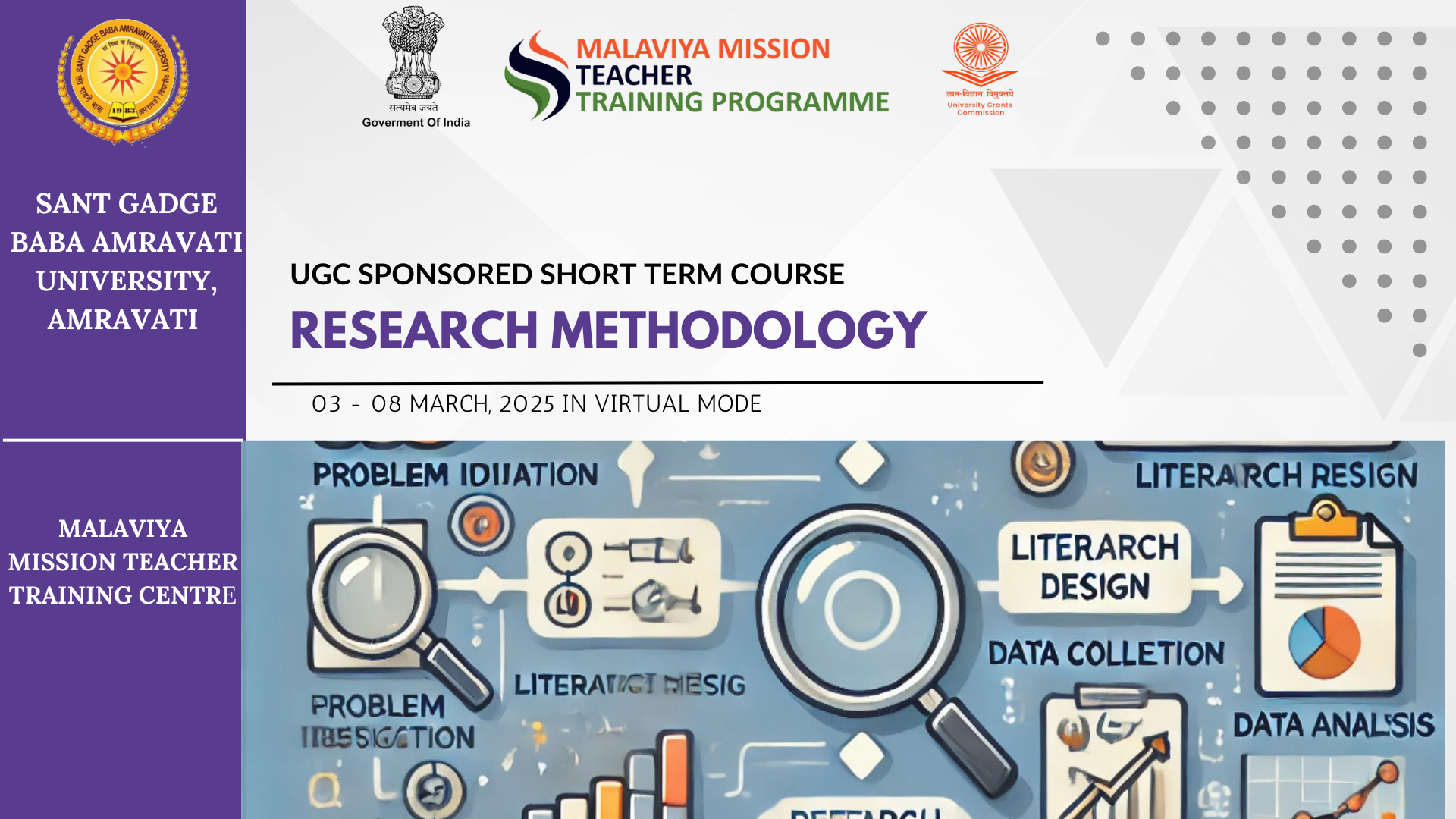
Research methodology is a fundamental aspect of academic inquiry, enabling scholars to conduct systematic, ethical, and impactful research. The UGC-Sponsored Short-Term Course in Research Methodology, organized by the Malaviya Mission Teacher Training Centre, Sant Gadge Baba Amravati University, aims to equip faculty members of higher education institutions with essential research skills, techniques, and best practices. This course will provide an in-depth understanding of research design, data collection, analysis, and ethical considerations, fostering a culture of high-quality academic research.
Upon completion of the course, participants will be able to: